

Love Beyond the Algorithm
Are there limits to Jesus’s invitation to love our neighbors?

Happy Valentine’s Day to all who celebrate. ❤️
It’s a good day to remember that different people define love differently in different places. Once when I was living in Mozambique, a friend stopped by to visit, and her toddler was cuddling her close as he was breastfeeding, pausing to play, coming back to nurse, releasing to snuggle, and then repeating the process all over again. I remarked (in her language), “he sure does love you,” and she made a weird laugh in her throat and said “Love??? When has he ever brought me anything to eat?”

(Once in a conversation about relationships, another friend from another village asked my husband, “In your culture, how do you show your wife you love her?” and Alan answered, “Well, some people give their spouses flowers.” This response was also followed by sarcastic laughter and comments like “If I gave my wife flowers, she would say, ‘How am I supposed to eat that?’”)
It’s not hard to see that in an economy of subsistence farming, sharing food is one of the highest forms of love. In a place where some years you’re not sure you’ll be able to feed your family, affectionate snuggling or admiring beautiful flowers might not qualify high enough for the concept of “love.”
It can be challenging to learn to see through someone else’s eyes or to try to imagine what life is like in their shoes (or sandals). Anytime we submit to the gift of hearing someone else’s experience, our own assumptions about reality that we’ve inherited from “our” community are de-centered and relativized.
I grew up in a community that taught children to sing often about how “Jesus Loves Me” —but I could also talk about how I love pizza or that new song playing on the radio. Obviously, we don’t mean the same thing in those two examples of the word “love” :)
What do we do with this slippery word love? Do I love God as much as I love my comfort level? Do I love my neighbor as much as I love my house? What if the answer is no? What do we do?
In the book of Mark, a scribe approaches Jesus after hearing several other groups debating him (Pharisees, Herodians, Sadducees are mentioned in the two sections right before this). He’s intrigued by how Jesus answered them well but refused to be baited by them, so he asks “So which commandment is the most important?” Jesus gives him a two-part answer by quoting from Deuteronomy 6 and Leviticus 19: “The first is, ‘Hear O Israel: The Lord our God, the Lord is one; you shall love the Lord your God with all your heart, and with all your soul, and with all your mind, and with all your strength.’ The second is this, ‘You shall love your neighbor as yourself.’ There is no other commandment greater than these.”1
When the scribe reflects Jesus’ answer back to him in agreement, Jesus tells him, “You’re not far from the Kingdom of God.” I always imagine the possibility of a twinkle in Jesus’s eye as he says this to the curious scribe—it’s like saying “You’re getting warmer… you’re sooooo close!” But we are left wondering what this guy did with his life after this. This guy had the “right answer” far above the Pharisees, Herodians, and Sadducees who had just been interrogating Jesus, but did he actually consider how he could re-center his life around the love of God and neighbor and then implement those changes?
We don’t know if that scribe evaluated his life and wrestled with what transformation was needed for his whole life to be rooted in profound love—this is really vulnerable work, and it’s best done within a courageous community. Anyone who wants to center God’s love for the world in their lives can, with courage, ask “How far am I willing to go with this love?” Another version of that question is “What am I holding back at arm’s length away from this love?”
Maybe it’s weird to say this in the “information age,” but I think one obstacle to love is lack of information. Or more specifically, some people’s understanding of love is limited partly because of corrupted information access. Let me connect the dots.
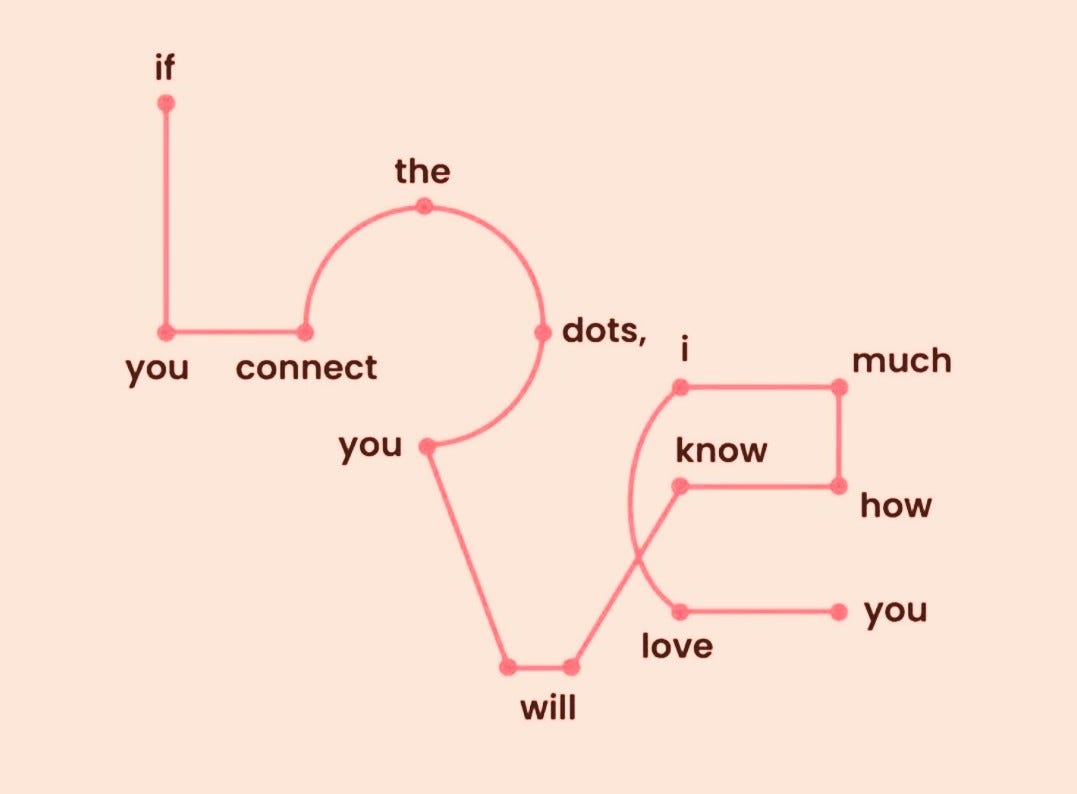
We already know that media literacy is an important skill in our time. We don’t want the elderly to be caught in Social Security scams and we don’t want teenagers to be bullied or body-shamed by others online. And we think it’s important for them to learn to be savvy in how they engage online because we love them. But what about my neighbors? The neighbors I know and the neighbors I don’t? Am I engaging with information in the world in a way that my neighbors can tell I care about them?
I think most of us already know that algorithms are feeding each person on their device selective inflammatory content. It’s a weird blend of active and passive choices; the algorithm in an application learns from the choices I put in—searches, queries, likes, and follows—but then it will serve me curated content based on those choices that becomes a continually amplified “more of the same.” It’s a smooth and swift highway into an echo chamber where we end up only hearing from people who we already agree with.2
It’s also a fast track to not knowing very many neighbors who aren’t just like me. And if I don’t know them or what their lives are like, I won’t know how to love them.
Jesus critiqued this isolationist definition of love in the Sermon on the Mount:
If you love those who love you, what reward do you have? Do not even the tax collectors do the same? And if you greet only your brothers and sisters, what more are you doing than others? Do not even the gentiles do the same?”3
Jesus consistently stretched his disciples’ expectations about who they should love—others, neighbors, strangers, enemies. (Check out the Parable of the Samaritan in Luke 10.25-37). We know that we need to be willing to be “inconvenienced” as we learn to love—sometimes an opportunity to show love arrives without prior warning.
But we also need to inconvenience ourselves as we access information online. The algorithm and/or your regular habits of accessing news and commentary needs to be subverted by Jesus’s invitation to love others who aren’t just like you. Many news programs have become “infotainment” that are polarizing viewers into fearing others and training them for disdain—or indifference. Other sources or email newsletters have such a narrow scope that they exclude many who are suffering in the world.

To really be learning to love others, neighbors, strangers, and enemies with Jesus, this must start with learning how they see the world, and how local and global events are affecting them. If we don’t subvert the algorithm or go out of our way to learn what we don’t already know, we will be ignorant of what’s happening to our neighbors. Being willing to fact check polarizing pundits and reject their lies, half truths, and conspiracy theories is part of loving others.
We can also grow our awareness of how to evaluate bias. The image below is a screenshot of The Media Bias Chart by the non-profit Ad Fontes Media. If you follow this link, you will see that it is an interactive tool that rates over 2000 media sources based on bias and reliability and is updated twice per year. The further outside the green box, the less reliable the source.
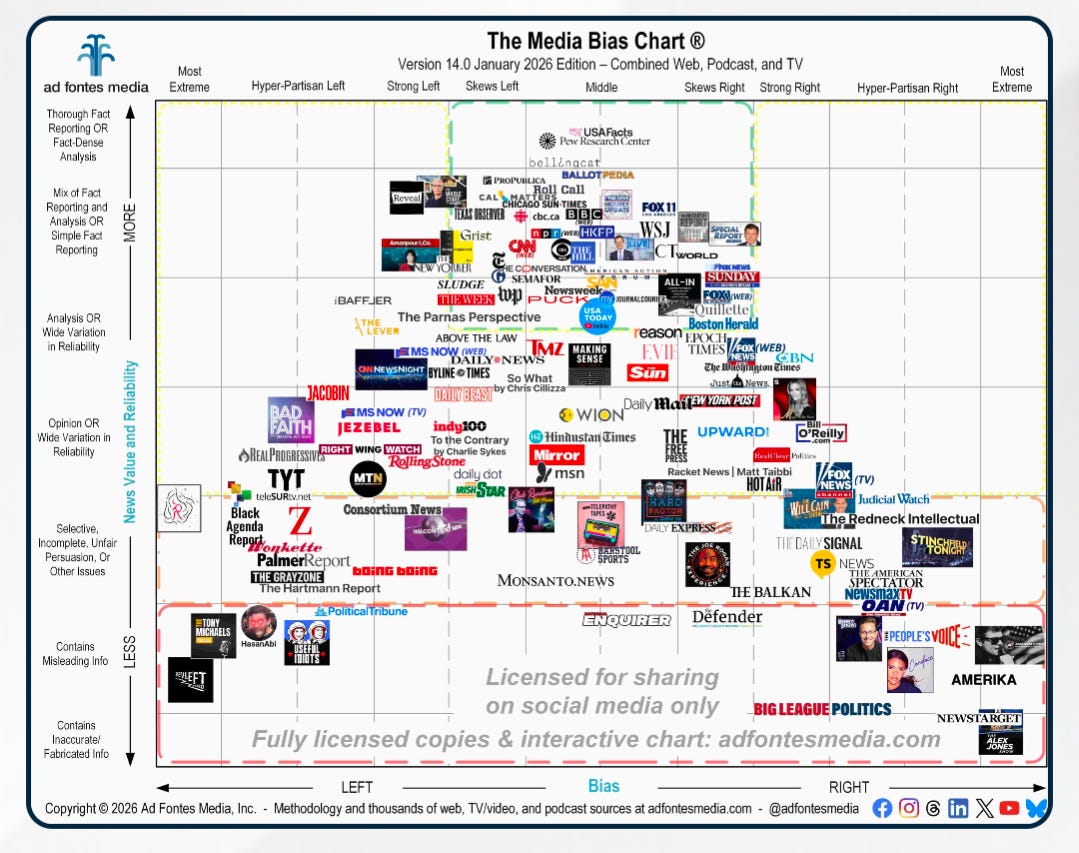
Maybe your strategy is to pick two sources on opposite sides of the green box in the Media Bias Chart and read about the same events from both sources and note how the different sources are trying to influence your interpretation. Maybe your strategy is to pick a topic and read a book. Maybe your strategy is to meet a neighbor in your town who is different from you and ask them to share with you their opinion about a recent world event.
It’s easy to quote Jesus’ words telling us to “Love God with all your heart, soul, mind, and strength, and love your neighbor as yourself.” But to begin to really ask “How can I start to love my neighbor as myself?” is incredibly disruptive to the rhythms and algorithms already flowing through our lives.
Am I engaging with information in the world in a way that my neighbors can tell I care about them? When we resist the urge to compartmentalize, we realize there’s no area of public life that we can put aside as an exception to Jesus’s invitation to love our neighbors. How will they know we love them?
We can stretch our definitions of love to include exchanging valentines, sharing meals, snuggling toddlers, eating pizza, and subverting the algorithm to expand our learning about injustice in the world. Jesus has a twinkle in his eye, telling us “You’re getting warmer… you’re soooo close!”
© 2026 Ladye Rachel Howell. All Rights Reserved.
Mark 12.29-31
This selective input is true even for those who protest, “I'm not on social media,” because the cookies in your browser history can be used toward the same ends, not to mention the plain bad habit of only getting news from one or two sites you already agree with.
Matthew 5.46-47